


Pruning Is Surgery: Every Cut Has a Consequence
A tree cannot heal a wound the way skin does; it can only seal over it, slowly, while fungi queue at the opening. That single fact explains everything in a sensible tree pruning guide: cut in the right place, at the right season, with the right size of branch, and the tree compartmentalises the wound and grows on; cut carelessly and you have handed decay a doorway it will use for a decade. Good pruning is nearly invisible — the tree looks like itself, only tidier and safer — while bad pruning announces itself for years in watersprouts, cracks, and dieback. This guide covers when to cut, where exactly the saw should go, what never to do, and when the honest answer is to call an arborist instead.
Timing: Dormant Season First, With Exceptions
For most trees, the best pruning window is late winter to early spring, while the tree is dormant but about to push growth: wounds seal fastest once spring growth starts, the branch structure is visible without leaves, and disease organisms are least active. There are important exceptions. Spring-flowering trees (lilac, magnolia, flowering cherry) should be pruned immediately after flowering, or you will cut off next season’s show. Maples and birches bleed sap heavily if cut in early spring — cosmetically alarming rather than dangerous, but avoidable by pruning them in mid-summer. Dead, damaged, and dangerous branches ignore the calendar entirely: remove them whenever you find them. And avoid pruning in autumn’s wet weeks in many climates, when fungal spores are abundant and the tree’s sealing response is slowing down.
The Three-Cut Method and the Branch Collar
Technique decides whether a wound seals or rots. Never cut flush with the trunk: the swollen ring at a branch’s base — the branch collar — contains the tissue that grows over the wound, and a flush cut removes it, leaving a wound that may never close. Never leave a long stub either, which dies back and rots into the trunk. The correct cut sits just outside the collar, angled slightly away from the trunk. For branches thick enough to tear bark under their own weight, use the three-cut method: first, an undercut a short distance out from the trunk; second, a cut from above beyond it, letting the branch fall without tearing; third, the final clean cut at the collar on the remaining stub. Sharp tools matter as much as geometry — a clean slice seals; a crushed, ragged one invites infection.
What to Remove (and What Never to Cut)
Work in priority order: dead, diseased, and damaged wood first; then crossing and rubbing branches, which wound each other continuously; then suckers and watersprouts draining energy; then, sparingly, thinning cuts that restore light and air to the crown. Two prohibitions protect more trees than any other rule in this tree pruning guide. Never “top” a tree — cutting the main leaders back to stubs — which triggers a thicket of weakly attached regrowth, invites decay into the large wounds, and destroys the tree’s structure permanently. And never remove more than about a quarter of the living crown in one year: the leaves you remove are the tree’s food factory, and a starved tree responds with stress growth and vulnerability. The pruned material, incidentally, has a second career — chipped branches and healthy prunings belong in the garden cycle described by our composting for beginners guide, where garden waste becomes next season’s soil.
Young Trees, Old Trees, and When to Call a Professional
Pruning goals change across a tree’s life. Young trees need formative pruning: establishing one strong leader, well-spaced scaffold branches, and removing competing stems early, when wounds are small and seal in a season — an hour of secateurs in year three prevents a chainsaw bill in year fifteen. Mature trees need restraint: mostly deadwood removal and hazard reduction, preserving the natural form. Call a professional when the work is above safe ladder height, near power lines, involves large limbs over roofs, or when you suspect internal decay (fungal brackets, cavities, sudden lean) — these are diagnosis and rigging problems, not gardening. Equally, any cut you cannot make with both feet on the ground and a hand tool deserves a second thought.
Tools and Safety: The Short, Serious List
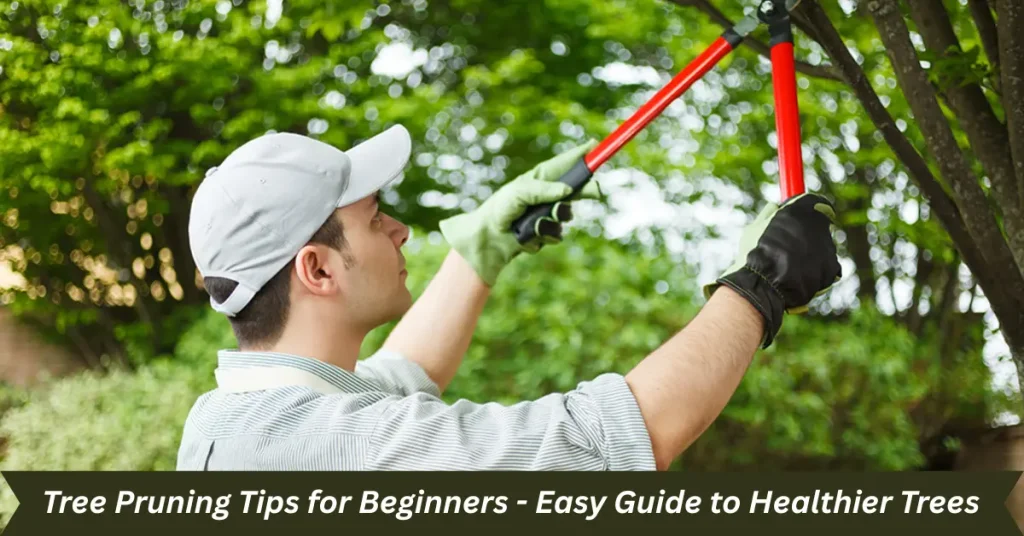
Good cuts require the right tool for the branch, used sharp. Secateurs handle pencil-thick growth; loppers reach thumb-thick branches and give leverage without tearing; a curved pruning saw is the correct tool for anything thicker — never a carpentry saw, whose teeth shred bark, and never an axe. Chainsaws belong to trained hands and large work; for most garden trees, the hand-tool trio suffices for an entire lifetime of maintenance. Keep blades clean and sharp: disinfect them between trees (a wipe of methylated spirit or diluted bleach) when disease is present, because tools are a proven disease highway between a sick tree and a healthy one. Safety is not a footnote: eye protection against falling debris, gloves, a stable ladder used only for positioning rather than cutting wherever possible, and an absolute rule — if the saw work is above your head or the branch could swing toward you, the job has crossed into professional territory. Most pruning injuries happen in exactly that grey zone of “just one more branch” from a ladder, which is why the boundary in this guide is drawn where it is.
One last judgement call: learn to recognise the tree that should not be pruned but removed, or left entirely alone. A veteran tree with cavities may be precious habitat and perfectly safe where it stands away from targets; a young tree planted in the wrong place will fight its pruning forever, and honest replacement beats a decade of corrective cuts. Pruning is a conversation with a living structure that will outlive the conversation — sometimes the wisest cut is none, and the best work a guide like this can do is give you the confidence to tell the difference.
The Bottom Line
A tree pruning guide in one paragraph: prune dormant-season where you can, cut just outside the branch collar with the three-cut method on heavy limbs, remove dead and crossing wood first, never top, never take more than a quarter of the crown, and escalate the big, high, or suspicious work to an arborist. Trees forgive small, clean, well-timed cuts remarkably well — it is the dramatic interventions they cannot recover from. Cut like a surgeon, not a hairdresser.


[…] cardboard and paper, straw, wood chips, and the woody prunings from work like the jobs in our tree pruning guide — supply carbon, structure, and air pockets, and they rot slowly. The working rule for beginners […]